Why Your Win Rate Doesn’t Matter in Memecoin Trading
The best wallets lose most of their trades. Here’s the maths that makes that work, and how to size and track your own trades so it works for you.

Merlin
Author
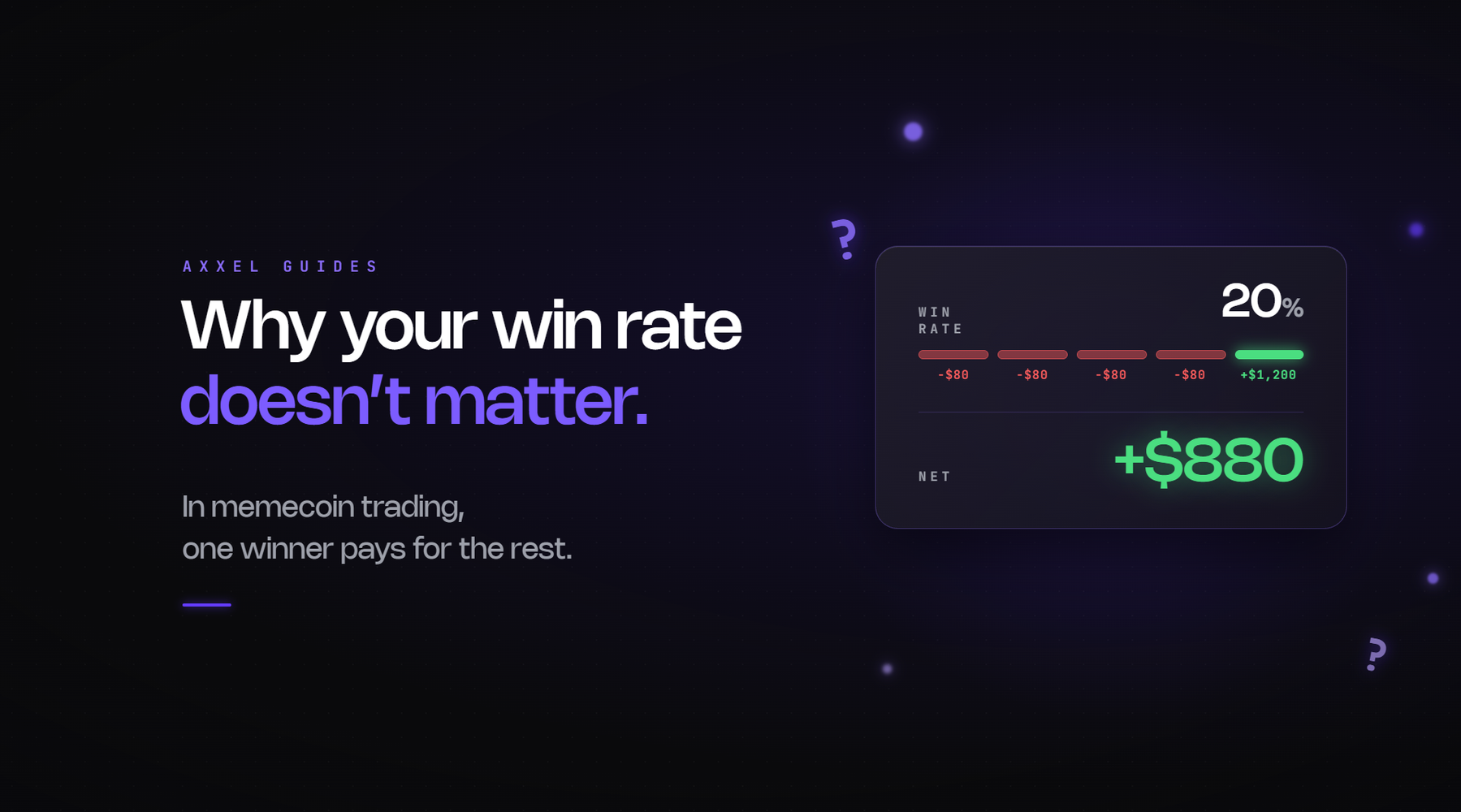
Ask a new memecoin trader how they’re doing and they’ll tell you their win rate. Ask a profitable one and they’ll tell you their biggest winner. That difference is the whole game.
In memecoins, the distribution of outcomes is lopsided. Most coins go nowhere or down, a few go up a lot, and a handful go up absurdly. A strategy built to be right often will take small wins on the few that run and hold through the many that don’t. A strategy built to be right big will lose small over and over and let the one that runs pay for all of it. The second one is how the top wallets trade, and it’s why their win rates look terrible.
The maths, in one line
What you make per trade on average is your win rate times your average win, minus your loss rate times your average loss. That number is called expectancy, and it’s the only number that decides whether you make money over a hundred trades.
Two traders, a hundred trades each:
- Trader A wins 70% of the time. Average win 0.3 of the position, average loss 0.5. Expectancy is (0.7 × 0.3) minus (0.3 × 0.5) = 0.21 minus 0.15 = +0.06 per trade. Barely positive, and one bad week wipes it.
- Trader B wins 25% of the time. Average win 3x the position, average loss 0.4. Expectancy is (0.25 × 3) minus (0.75 × 0.4) = 0.75 minus 0.30 = +0.45 per trade. Seven times the edge, with a win rate that would get them laughed out of a group chat.
Trader B loses three trades out of four. It doesn’t matter.
Why memecoins punish the high win rate
A high win rate on memecoins usually means you’re taking profit early. You buy, it goes up 30%, you sell, you feel good. The coin then does a 10x and you watch it from the sidelines. You were right and you got paid a fraction of what being right was worth. When to sell a memecoin is the fuller version of that problem, but the short version is that the early exit is where most high-win-rate accounts leak their edge.
The other way it happens is holding losers. To keep the win rate up, you don’t sell the red ones, you “wait for them to come back”, and a 40% loss becomes a 90% one. Why do I keep losing money covers the psychology; the maths is simply that one 90% loss needs a 10x to recover.
R multiples: the unit that makes this trackable
Pick the amount you’re willing to lose on a trade before you enter. That’s 1R. If you put $200 in with a stop at a 50% drawdown, 1R is $100. Every outcome is then measured in R: a trade that makes $300 is +3R, a trade that stops out is -1R.
Now your log tells the truth. Ten trades at -1R and one at +15R is +5R for the month, which is a good month, even though you lost ten out of eleven. It also exposes the trades that quietly kill accounts: the -4R, where you didn’t honour the stop. One of those undoes four good losses.
Setting up for asymmetry
- Decide the loss first. Enter with a stop loss and take profit already set, so -1R is the worst case and it’s automatic.
- Size for being wrong. Position sizing is where the 1R comes from. If -1R hurts, the position is too big to hold through the noise, and you’ll sell the winner early.
- Let winners run with a trailing stop rather than a fixed target, so the 15R stays possible. A fixed take profit at 2x caps your best trade at +2R, which breaks the whole model.
- Take the loss at -1R every time. The stop is the edge. Moving it is the leak.
- Only take trades where a big outcome is plausible: a live meta, early holders growing, liquidity deepening. Signs a memecoin is about to run is the checklist. A coin that can only do a 2x can’t fund your losses.
How to track it
A spreadsheet with five columns: date, coin, 1R in dollars, result in R, and one line on why you took it. After fifty trades you’ll know your real win rate, your average win in R, and your expectancy. If the expectancy is negative, the fix is almost never “win more often”. It’s “lose smaller” or “hold the winners longer”, and the log shows which.
Axxel supports Solana, Ethereum, Base, BNB Chain and Robinhood Chain, with stop loss and take profit on every trade, trailing stops for letting winners run, limit orders for planned entries, and adjustable slippage. The fee is a flat 0.9% on every trade, and your keys stay yours.
This article is for information only and is not financial advice. Crypto assets are high risk and you can lose everything you put in.