What a Token Risk Score Actually Checks (and What It Can’t)
The number next to the price is a filter, not a verdict. Here’s what goes into it, what it misses, and how to read a “caution” without panicking or ignoring it.

Merlin
Author
Risk scores are everywhere now: RugCheck, GoPlus, DexScreener’s audit badges, and the score inside whatever terminal you trade on. They’re useful and they’re misunderstood in both directions. New traders treat a green score as permission to size up. Experienced ones ignore the score entirely and miss the one time it would have saved them. The right use is in between, and it starts with knowing what’s actually being checked.
What goes into the number
Scores differ, but they’re built from the same handful of on-chain facts:
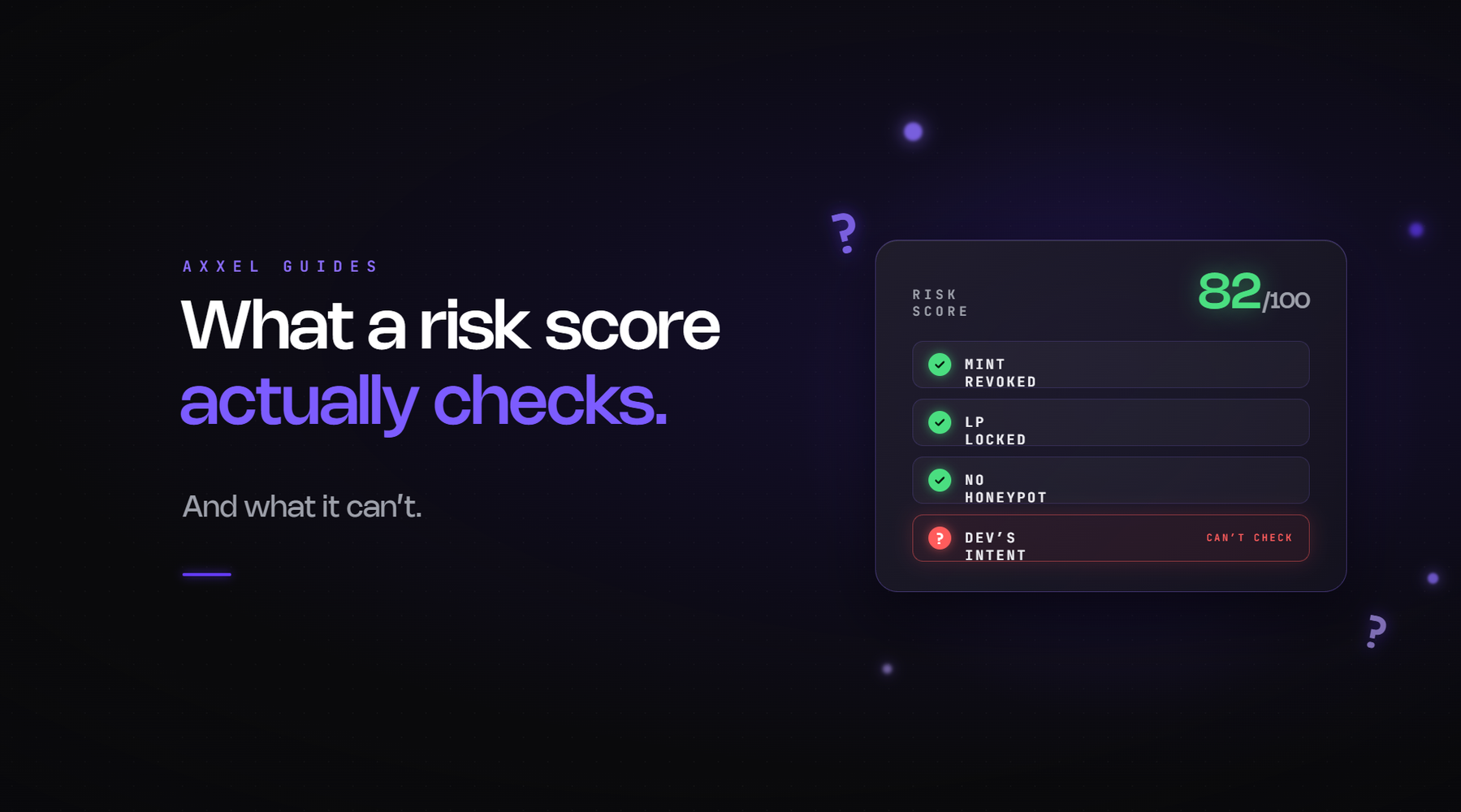
- Mint authority. On Solana, can the dev create more tokens? If so, your supply can be diluted to nothing without the pool ever being touched.
- Freeze authority. Can the dev freeze token accounts, stopping you from selling?
- Liquidity. How deep is the pool, and can it be withdrawn? How liquidity works is the background; a thin pool means your exit moves the price.
- Holder concentration. What share do the top ten wallets hold, and do they look like one person? Holder distribution explains how to read it; bundled launches are what a bad reading usually means.
- Honeypot and tax checks on Ethereum-style chains. A simulated buy and sell to confirm you can actually exit, and at what tax. Honeypots are the thing this catches.
- Contract flags. Verified source, proxy or upgradeable contracts, ownership not renounced, functions that let the owner change rules after launch.
- Token age and dev history. Minutes old with a deployer who’s launched twenty tokens this month scores worse than a week-old coin from a clean wallet. Finding the deployer is how to check this yourself.
Each check is weighted, added up, and turned into a number or a colour. A “caution” usually means one or two of these flagged, not that the coin is a scam.
What the score can’t see
The score reads the contract and the pool. It doesn’t read intent.
- A dev who holds 8% across four wallets and sells into every pump passes every check. Signs a dev is about to sell covers what to watch instead.
- A coin with perfect on-chain hygiene and no holders, no community and no reason to exist will go to zero cleanly and legally.
- Wash-traded volume doesn’t lower a score. The pool is fine; the activity is fake.
- A slow rug, where the team drains the treasury over weeks, never trips a flag.
- Scores are a snapshot. A coin can score well at launch and badly an hour later when a wallet cluster appears. Re-check before adding.
How to read a “caution”
Don’t treat it as a stop sign or a dare. Open the detail and find which check flagged. Top-ten concentration at 35% on a two-hour-old coin is normal and often just the early buyers; the same number on a week-old coin with “LP locked for 7 days” is a different story. Mint authority not revoked on Solana is close to a hard no. A medium score with one flag you understand is tradeable with smaller size. A medium score with three flags you don’t understand isn’t.
The right order
- Score first, as the filter. A bad score saves you the next ten minutes.
- Then the holder map and the transaction feed, which show the behaviour the score can’t.
- Then the full research pass if you’re sizing up.
The score tells you whether the coin can rug you mechanically. The rest tells you whether the people behind it will. You need both, and a green number only answers the first.
Axxel shows live price, chart, liquidity and a risk score on every token across Solana, Ethereum, Base, BNB Chain and Robinhood Chain, with buy and sell tax limits that block a trade if a token’s tax is above the level you set. The fee is a flat 0.9% on every trade, and your keys stay yours.
This article is for information only and is not financial advice. Crypto assets are high risk and you can lose everything you put in.