Dip or Rug? The 60-Second Check When a Memecoin Drops
Your coin just fell 30% in a minute. Here’s how to tell a shakeout from an exit before you do something expensive.

Merlin
Author
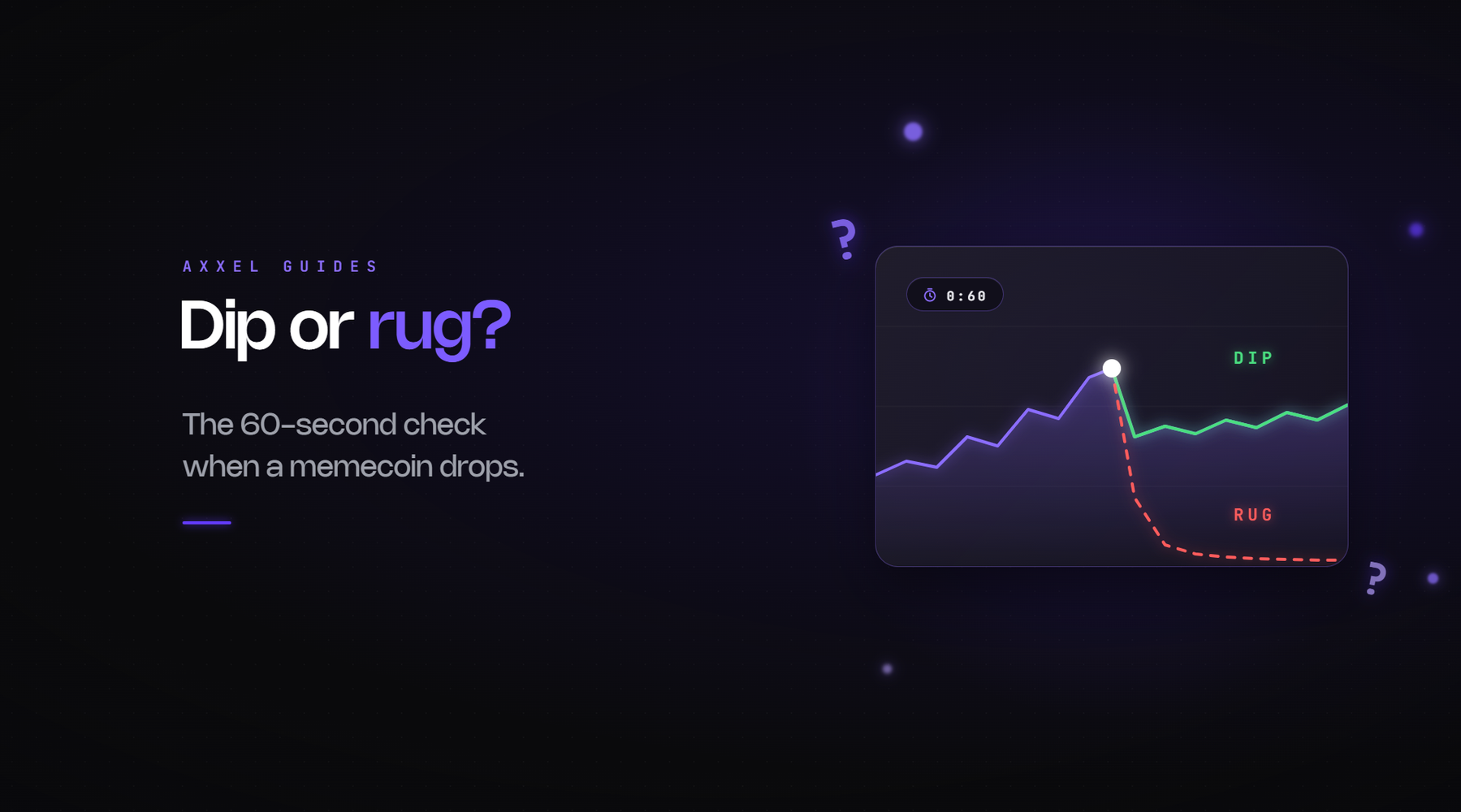
There’s a specific feeling when a coin you’re holding drops 30% in a single candle. Your hand moves to the sell button before your brain has done anything. Sometimes that’s right. Often it’s the exact moment a shakeout bottoms, and you’ve sold the low to whoever just caused it.
The fix isn’t to never panic-sell. It’s to have an order of checks that takes under a minute, so the decision is made by what’s on-chain rather than by your pulse. Do the checks in this order every time, and the decision usually makes itself.
Second 0 to 15: is the liquidity still there?
This is the only check that tells you whether you can exit at all. Open the pair and look at the pool. If liquidity has gone from $200k to $4k, the pool was pulled, that’s a rug, and the only question is whether anything is left to sell into. Sell whatever you can, immediately, and read the rest of this later.
If liquidity is roughly where it was, the price moved because someone sold into it, not because the floor was removed. Move to the next check.
Second 15 to 35: who sold?
Open the transaction feed and look at the biggest red rows in the last couple of minutes. There are only four answers, and each one tells you something different:
- The dev or a wallet funded by the dev. That’s distribution and it rarely stops at one sell. Signs a dev is about to sell covers how to confirm the link, but if you already know the deployer’s wallet, this takes five seconds. Cut.
- A wallet from the first block. A sniper taking profit. Normal, finite, and usually the cause of the sharpest early dips. Not a reason to sell on its own.
- One big holder you don’t recognise. Check how much they still have. If they sold half and kept half, they’re trimming. If they sold everything, there may be more like them, and the holder distribution will tell you how many.
- Lots of small sells at once. Retail panicking at the same candle you’re looking at. This is the shape of a shakeout, and it’s the one that bounces most often, as long as the next check holds.
Second 35 to 50: are holders leaving or arriving?
Holder count during the drop is the tell most people skip. If holders are flat or still rising while price falls, people are buying the dip and the sellers are a few big hands. If holders are falling fast, the crowd is exiting and the bounce you’re hoping for has nobody to make it.
Pair that with the buys in the feed. A sharp drop that’s being met with steady buys of decent size is a different animal to a drop into silence.
Second 50 to 60: decide
Three outcomes, and you should know which one before the minute’s up.
- Liquidity gone, or the dev selling: out, now. Don’t wait for a bounce to “sell better”. There isn’t one.
- Snipers or one whale, holders steady, buys showing up: hold, and if it was already on your plan, this is where a limit buy sits, not a panic sell.
- Retail panic, holders dropping, no buys: cut to your stop. Not because it’s a rug, but because the thing that made it a trade has gone.
If you can’t tell which it is in a minute, that’s an answer too: reduce to a size you can be wrong at and finish the research after.
Make the minute automatic
Most of this gets easier if the decision was made before the drop. A stop loss set at entry means the “retail panic” case handles itself, and you only need the minute for the question of whether to hold through or add. Keeping the deployer’s wallet in your notes when you buy turns the “who sold” check into a glance. And position sizing that lets you watch a 30% candle without your hands shaking is what makes the other 55 seconds possible.
The traders who survive memecoins aren’t the ones who never get caught in a dump. They’re the ones who can tell, in a minute, which kind of dump it is.
Axxel supports Solana, Ethereum, Base, BNB Chain and Robinhood Chain, with stop loss and take profit on every trade, limit orders for planned dip buys, live liquidity on every token, and buy and sell tax limits that block a trade if a token’s tax is above the level you set. The fee is a flat 0.9% on every trade, and your keys stay yours.
This article is for information only and is not financial advice. Crypto assets are high risk and you can lose everything you put in. Axxel is not available to UK or US persons.