How to Spot a Rug Pull Before You Buy: A 60-Second Checklist
Most rugs are visible on-chain before they happen. Here's what to look at.

Merlin
Author

Most people who get rugged didn't get outsmarted. They just didn't look.
The uncomfortable truth about rug pulls is that the majority are visible in advance. Not all — some are genuinely sophisticated, and some tokens die slowly rather than in one transaction. But the standard rug leaves the same fingerprints every time, and they're public before anyone loses money.
This is the check. It takes under a minute once you know what you're looking at.
First: what a rug actually is
The word gets used for anything that goes down, which muddies the useful distinction. Three different things get called a rug:
The liquidity pull. The classic. The team removes the liquidity backing the token, and the price goes to effectively zero in one transaction. Nothing you can do once it happens — you have to catch it beforehand.
The honeypot. You can buy. You cannot sell. Usually written into the contract, sometimes activated after launch by changing the sell tax to something absurd. Your wallet shows a balance; the balance is unreachable.
The slow bleed. No single malicious transaction — the team just dumps their supply into every green candle until nothing's left. Technically not a rug. Same outcome for you.
Different mechanics, one shared tell: the team holds enough supply or control to do it. That's what you're checking for.
The checklist
1. Supply concentration — the single most important number.
Look at what the top ten wallets hold. If a small number of addresses control most of the supply, everything else on this list is academic — they can end the token whenever they choose, and eventually someone will.
A caveat that catches people out: not every large holder is a red flag. Locked team allocations, burn addresses, and liquidity pool contracts all show as big holders. Learn to tell them apart, or you'll pass on fine tokens and buy bad ones.
The thing that should actually worry you is many fresh wallets holding suspiciously similar amounts, all funded around the same time. That's one entity pretending to be a crowd.
2. Is the liquidity locked or burned?
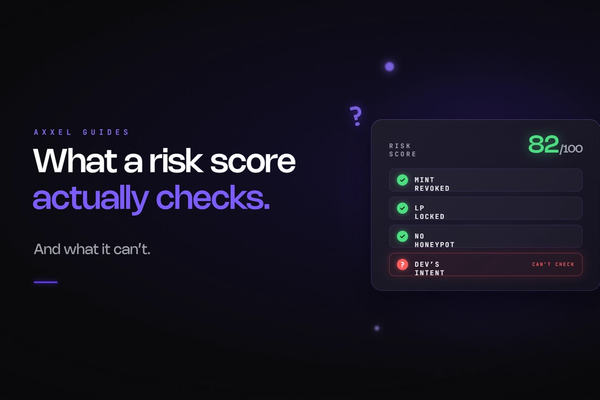
Locked liquidity means it can't be withdrawn until a set date. Burned means it's gone permanently and can never be pulled.
Unlocked liquidity means the team can remove it at any moment. That's the classic rug, and it takes one transaction. If liquidity isn't locked or burned, you're trusting the team's goodwill — which is a position you can take, just take it knowingly and size accordingly.
Also check when the lock expires. A lock with three days left is barely a lock, and rugs are frequently timed to the unlock.
3. Buy and sell tax.
Many contracts charge a tax on trades. Some are legitimate — funding marketing or liquidity. Some are extraction.
The number matters, but the changeability matters more. If the contract lets the team modify the tax after launch, a reasonable 3% today can become 99% tomorrow, which is a honeypot with extra steps. Check both the current rate and whether it can be raised.
This is one you can automate rather than eyeball. In Axxel, you can set maximum acceptable buy and sell tax limits in settings, and orders simply won't execute on a token that breaches them. That's a one-time setup that filters out an entire category of bad trade without you having to remember.
4. Can you actually sell?
The honeypot check. The reliable way is empirical: buy a small amount, then immediately try to sell a portion of it. If the sell won't go through, you've learned it for a few dollars instead of your position size.
Token scanners will flag obvious honeypots, and they're worth running — but they aren't infallible, particularly against contracts designed to pass automated checks and turn hostile later. The small test sell is slower and more reliable.
5. Bundle activity at launch.
Check the first block or two. If a large share of the supply was bought in the opening moments by wallets that look connected — funded from the same source, buying identical amounts, moving in lockstep — the launch was farmed before the public saw it.
That doesn't guarantee a rug. It does guarantee you're buying from people whose entry was vastly better than yours, and who need someone to sell to.
6. Contract ownership.
A renounced contract means the deployer gave up the ability to modify it — no changing taxes, no minting more supply, no pausing trades. Renounced is generally safer.
But renounced isn't a clean bill of health. A contract can be renounced with hostile code already in it, and renouncing doesn't stop the team dumping tokens they already hold. Treat it as one input, not a verdict.
7. The chart and holder count together.
Volume can be manufactured. A token can look busy while being one bot trading against itself. Volume rising with a flat or falling holder count is the pattern to be suspicious of — real interest brings new holders, wash trading doesn't.
The sixty-second version
When something's moving and you don't have time for the full pass:
- Top-10 supply concentration — is it distributed or controlled?
- Liquidity — locked, burned, or neither?
- Sell tax — reasonable, and can it be changed?
- Holder count — growing, or flat while volume spikes?
- Bundles — was most of the supply taken in the first block?
Any one of those failing badly is enough to skip. There's always another token.
What the checklist doesn't cover
Being honest about the limits matters more than the checklist itself.
Passing every check doesn't make a token good. It makes it not-obviously-rugged. The overwhelming majority of memecoins still go to zero without any malicious act — they just run out of attention. Checking the contract protects you from theft, not from the base rate.
Which means the checks are necessary and nowhere near sufficient. Position sizing does the heavier lifting: assume a total loss on every position and size so that's genuinely survivable. A trader who does no checks but sizes properly will outlast one who checks obsessively and over-allocates.
Setting it up once
Some of this is judgement you have to apply each time. Some of it can be configured once and forgotten.
The checks still need you. The settings just mean the obvious ones happen automatically.
Axxel lets you set maximum buy and sell tax limits and slippage in settings so orders won't fire on tokens that breach your thresholds, and includes token analysis and MEV protection across Ethereum, Base, BSC and Solana. Flat 0.9% per trade, non-custodial, no subscription. Try it here.
Crypto trading carries risk. Most memecoins lose value. Nothing here is financial advice. Axxel is not available in all regions.